
Prizes in SigmaPhi 2023
The SigmaPhi Prize for 2023 has been awarded during the SigmaPhi2023 Conference
to Amnon Aharony, David K. Campbell, Martin Löwen, Chandan Dasgupta, John M. Kosterlitz, and Jürgen Kurths.
2023 SigmaPhi Prize:

During the conference, four works selected out of all the oral and poster presentations have been awarded.
The selection committee was composed by V. Constandoudis and A.M. Scarfone
Any awarded scientists have been granted 500 euros each. Additionally, the registration fee will be waived for the winners for participating in the next edition of the SigmaPhi Conference, SigmaPhi2026.
The announcement of the winners and the awarding ceremony took place on Friday, July 14th.
The winners are:

Peter Ván (Wigner Research, Centre for Physics, Hungary)
Prize for the best oral presentation on Theoretical Statistical Physics
Title of the work: Classical holography
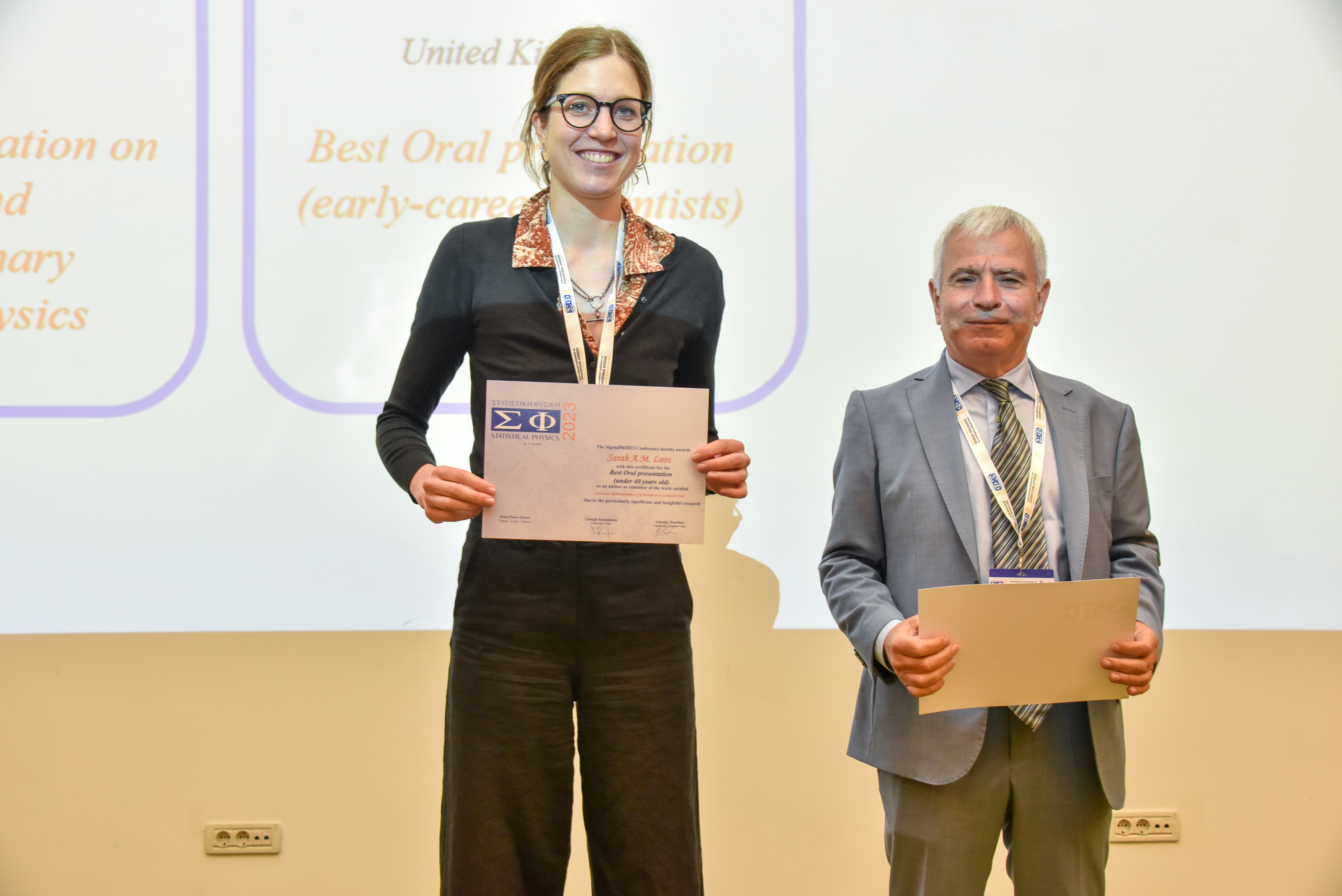
Sarah A.M. Loos (University of Cambridge, UK)
Prize for the best oral presentation (early-career scientists)
Title of the work: Stochastic thermodynamics of a particle in a correlated field
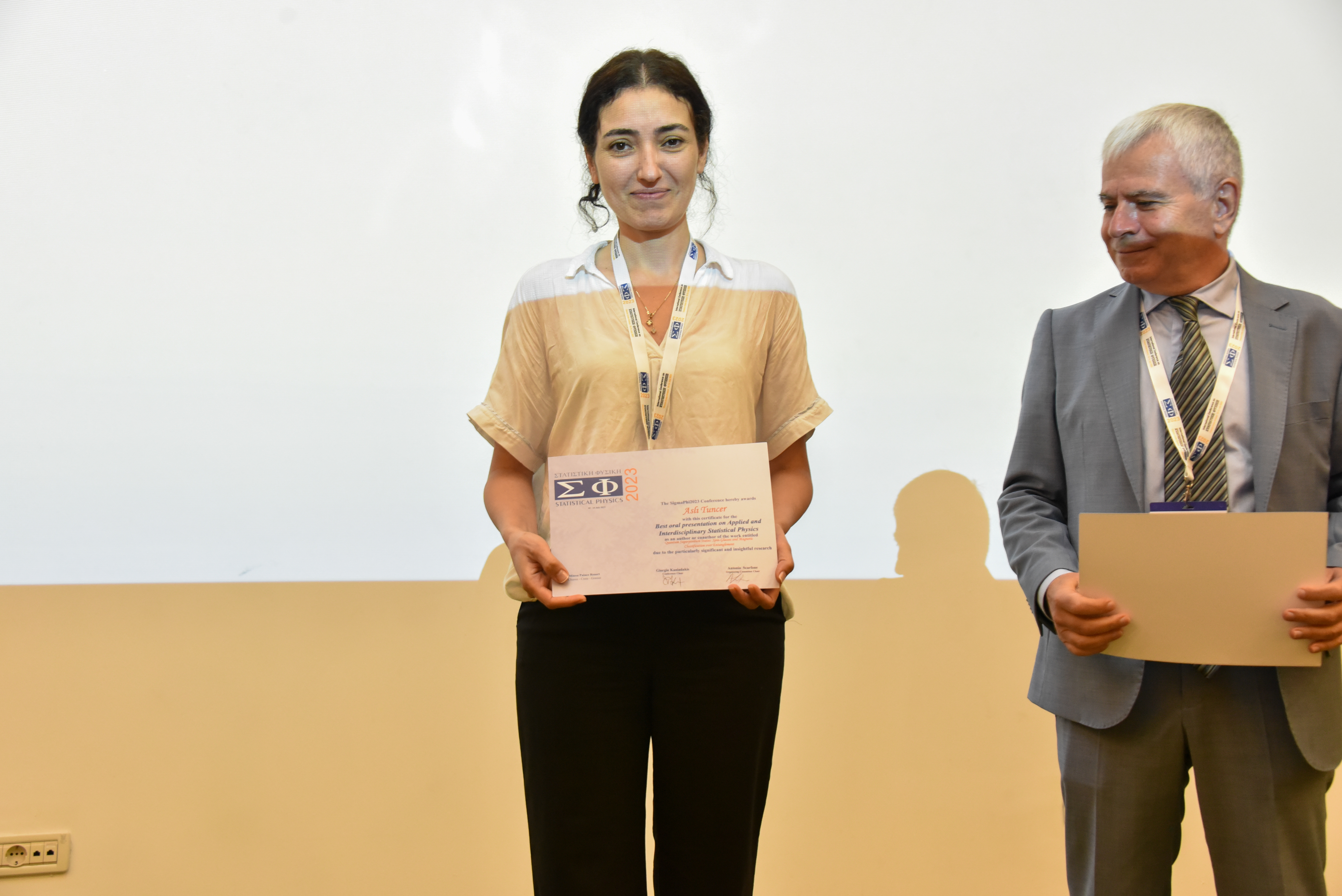
Asli Tuncer (Koç University, Turkey)
Prize for the best oral presentation on Applied and Interdisciplinary Statistical Physics
Title of the work: Quantum superposition states: Spin-glasses and magnetic classification over entanglement

Katarina Karlova (J. Šafárik University, Slovakia)
Prize for the best poster presentation
Title of the work: Frustrated magnetism of a quantum mixed spin-(1, 1/2) Heisenberg octahedral chain from a statistical-mechanical monomer-dimer model
Prizes in SigmaPhi 2017
The SigmaPhi Prize for 2017 has been awarded during the SigmaPhi2017 Conference
to Ralf Metzler, David Mukamel, and Stefano Ruffo.
2017 SigmaPhi Prize:
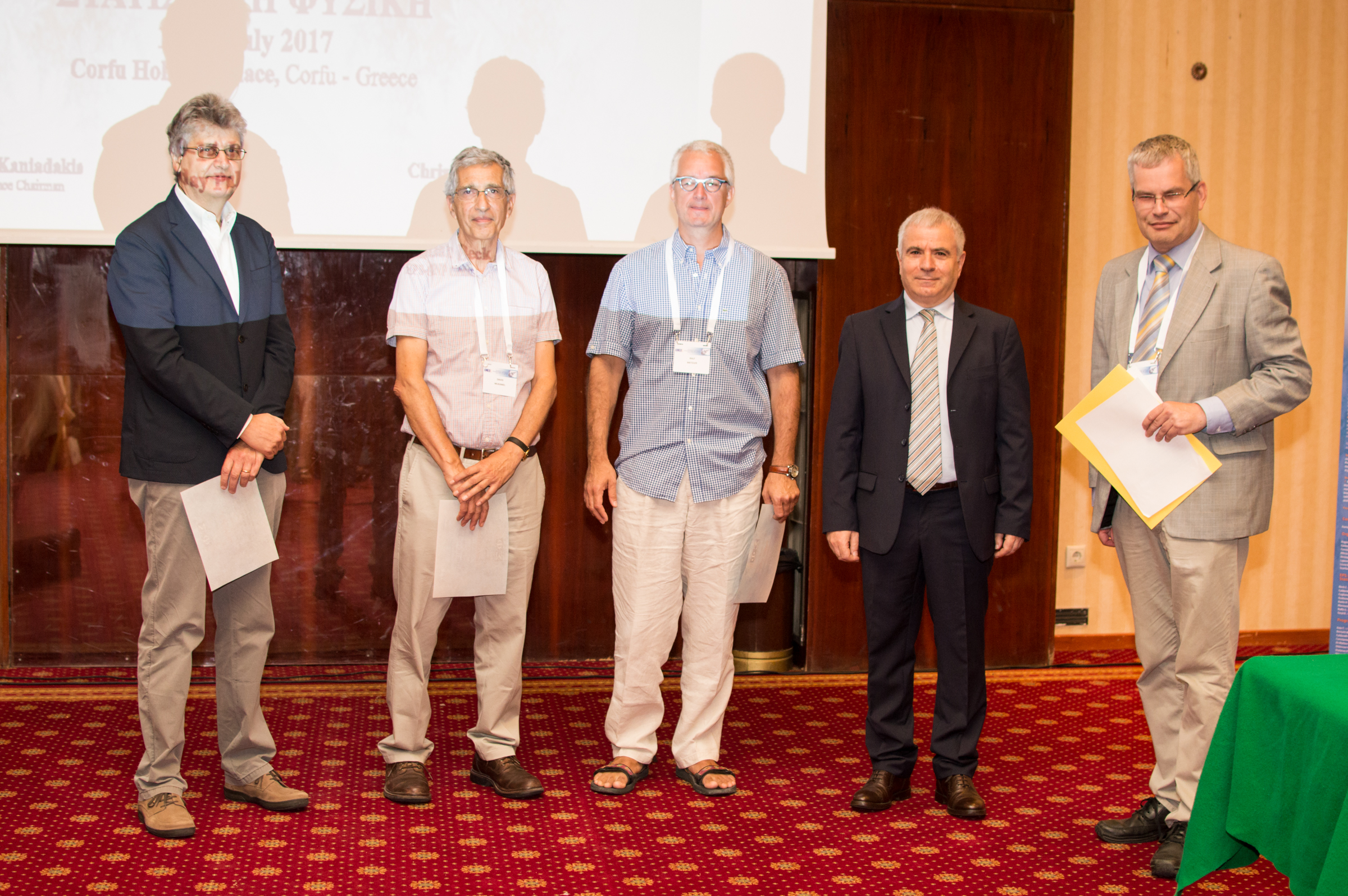
From left to right: Stefano Ruffo (SigmaPhi 2017 Prize), David Mukamel (SigmaPhi 2017 Prize), Ralf Metzler (SigmaPhi 2017 Prize), Giorgio Kaniadakis (Chairman of SigmaPhi Conference), Cristian Beck (Chair of EPS-SNLP Division)
Short biography: Ralf Metzler studied physics at Ulm University and had postdocs at Tel Aviv University and MIT. He has held faculty positions at the Nordic Institute for Theoretical Physics, Copenhagen, University of Ottawa, Technical University of Munich, Tampere University of Technology, and University of Potsdam. He has been developing the fractional Fokker-Planck equation framework, the concept of time averaging of stochastic processes and their ageing and non-ergodic behaviour. Moreover, Ralf has been involved in the study of diffusion-based molecular regulation and first passage processes, as well as simulations of soft matter dynamics with crowding.
David Mukamel: for his outstanding contributions to the understanding of the role of symmetry in equilibrium and out-of-equilibrium phase transitions
Short biography: David Mukamel studied physics at The Weizmann Institute and was a postdoctoral fellow at Brookhaven National Lab and Cornell University. He has been holding a faculty position at The Weizmann Institute since 1977. In his studies, he combined statistical physics with group theoretical methods to study the collective behavior of many-body systems in and out of thermal equilibrium. His studies on long-range order and long-range correlations contributed to the understanding of these phenomena in diverse classes of physical systems, including magnets, liquid crystals, DNA melting, driven systems, and others.
Stefano Ruffo: for his outstanding contributions to the statistical and dynamical behaviour of systems of nonlinear coupled oscillators and with long-range interactions.
Short biography: Stefano Ruffo is the Director of the International School for Advanced Studies (SISSA) in Trieste. He has been the Chairman of the Statistical Physics Commission of IUPAP in 2012-2014. He is a member of the Scientific Advisory Board of the E. Schroedinger Institute (2016-18) and of the Board of the Statistical and Nonlinear Physics Division of the EPS (2016-18). Among his scientific achievements, one can mention the numerical evidence of the transition to equipartition in the Fermi-Pasta-Ulam (FPU) model, the demonstration of the thermodynamic limit of the Lyapunov spectrum, the introduction of the concept of chaotic breather, the discussion of quasi-stationary states in the Hamiltonian Mean Field Model (HMF) and of ensemble inequivalence in systems with long-range interactions.
During the conference, six works selected out of all the oral and poster presentations have been awarded.
The prizes have been supported by the following institutions:
- European Physical Society (EPS).
- National Institute of Nuclear Physics (INFN), Italy.
- Greek National Centre for Scientific Research DEMOKRITOS financed by Greek Telecom (OTE).
- Chaos, Solitons and Fractals journal (Elsevier).
- SigmaPhi Conference.
The selection committee was composed by V. Constandoudis and A.M. Scarfone
Any awarded scientists have been granted 500 euros each. Additionally, the registration fee will be waived to the six winners for participating in the next edition of the SigmaPhi Conference, SigmaPhi2021.
The announcement of the winners and the awarding ceremony took place on Friday, July 14th.
The winners are:

Jozef Streka (P. J. Safarik University, Kosice, Slovak Republic)
Prize for the best oral presentation on Theoretical Statistical Physics
Title of the work: Strong and weak-universal critical behaviour of a mixed-spin Ising model with a three-spin interaction on the Union Jack lattice

Richard Mace (University of KwaZulu-Natal, Durban, South Africa)
Prize for the best oral presentation on Applied Statistical Physics
Title of the work: Linear waves and instabilities in plasmas with kappa velocity distributions
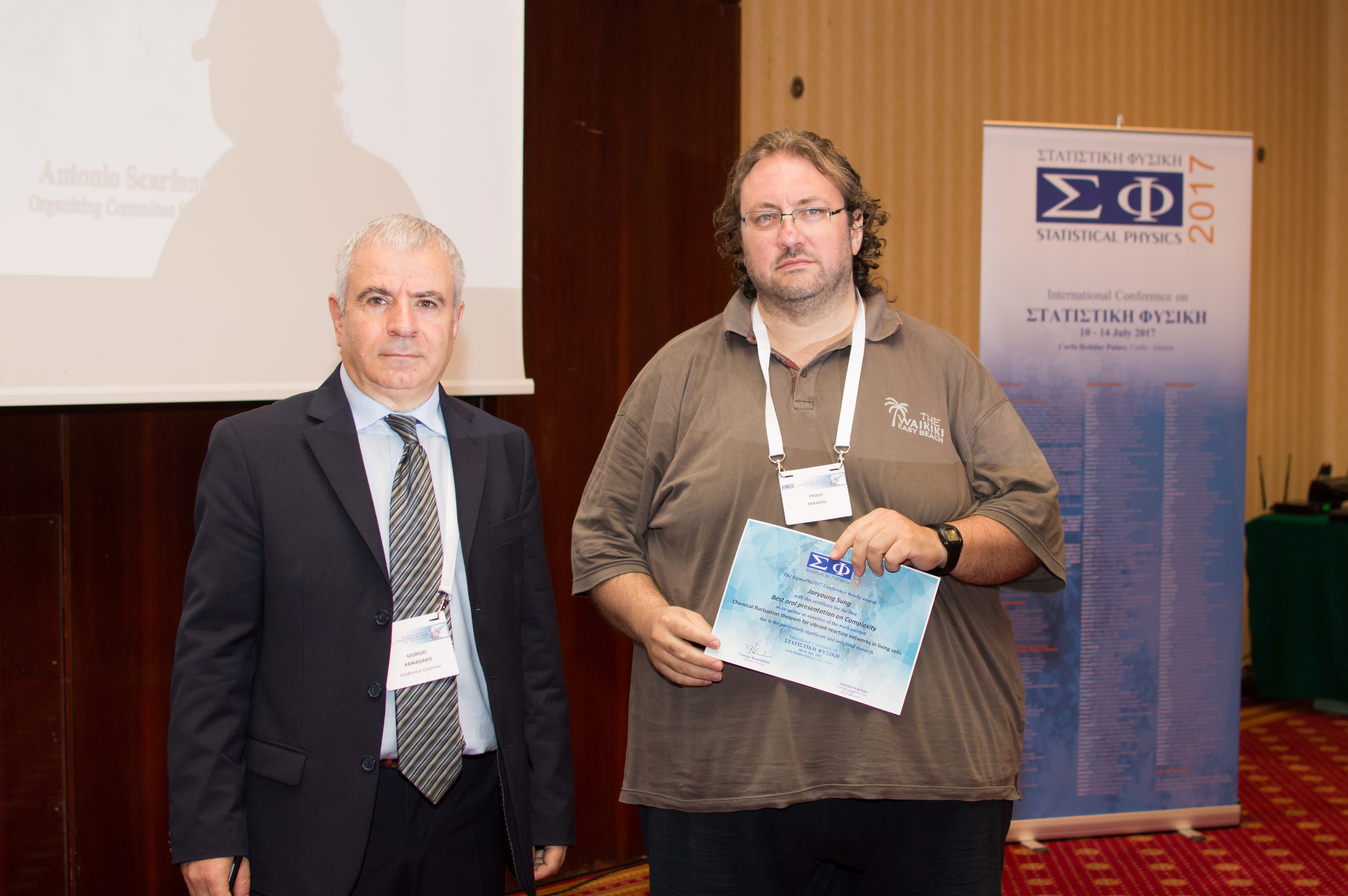
(Chung-Ang University, Republic of South Korea)
Collect the award Paolo Paradisi, chair of the workshop: Complexity and self-organization in biology and physiology)
Prize for the best oral presentation on Complexity
Title of the work: Chemical fluctuation theorem for vibrant reaction networks in living cells
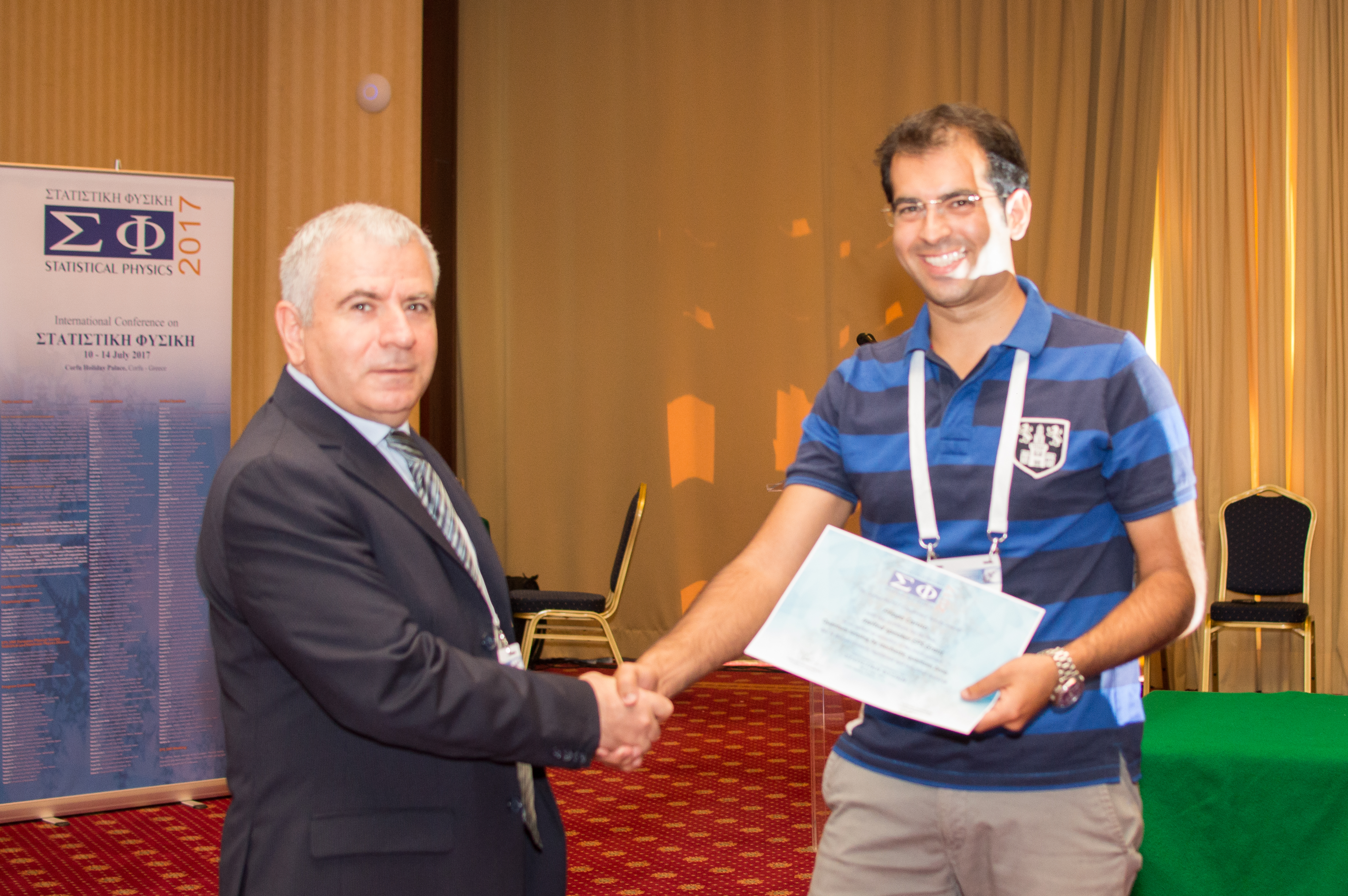
Filippo Caruso (LENS, QSTAR, University of Florence, Italy)
Prize for the Invited speaker Grant
Title of the work: Quantum Sensing by Stochastic Quantum Zeno
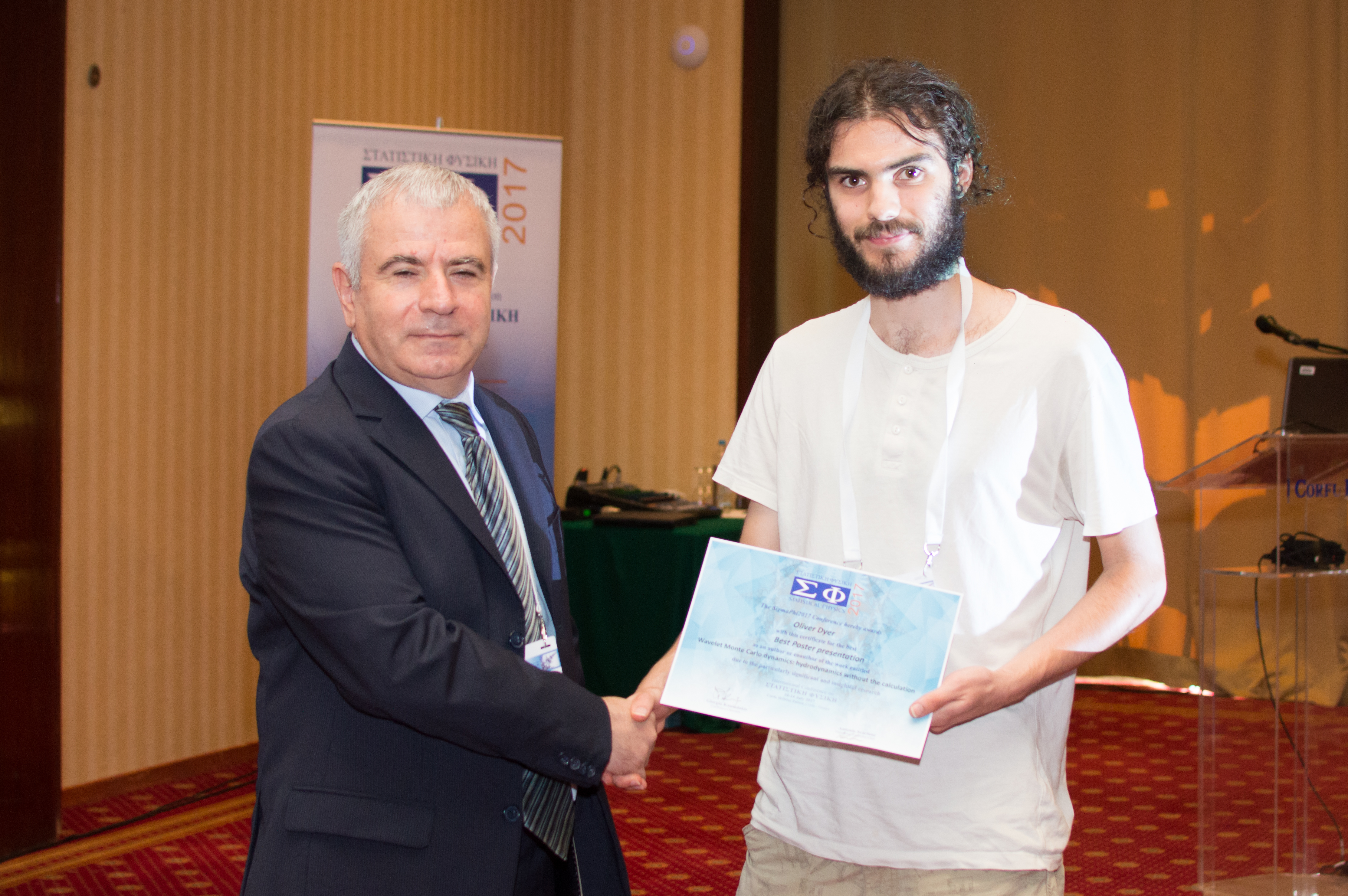
Olly T. Dyer (University of Warwick, UK)
Prize for the Best Poster presentation
Title of the work: Wavelet Monte Carlo dynamics: hydrodynamics without the calculation

Yuka Fujiki (Hokkaido University, Japan)
Prize for the Best Poster presentation by PhD student
Title of the work: Disassortative degree mixing and fractality of scale-free networks
Prizes in SigmaPhi 2014
During the conference, three works selected out of all the oral and poster presentations by scientists under 40 years have been awarded.
The prizes have been respectively offered for the:
- Best Work on FOUNDATIONS OF STATISTICAL PHYSICS (offered by the POLITECNICO di TORINO).
- Best Work on COMPLEXITY (offered by CHAOS, SOLITONS and FRACTALS Journal).
- Best POSTER PRESENTATION (offered by the Greek National Center for Scientific Research DEMOKRITOS).
The selection committee was composed by V. Constandoudis, P. Paradisi, and A.M. Scarfone
The three awarded scientists have been granted 500 euros each. Additionally, the registration fee will be waived for the three winners for participating in the next edition of the SigmaPhi Conference, SigmaPhi2017.
The announcement of the winners and the awarding ceremony took place on Friday, July 11th.
The winners are:
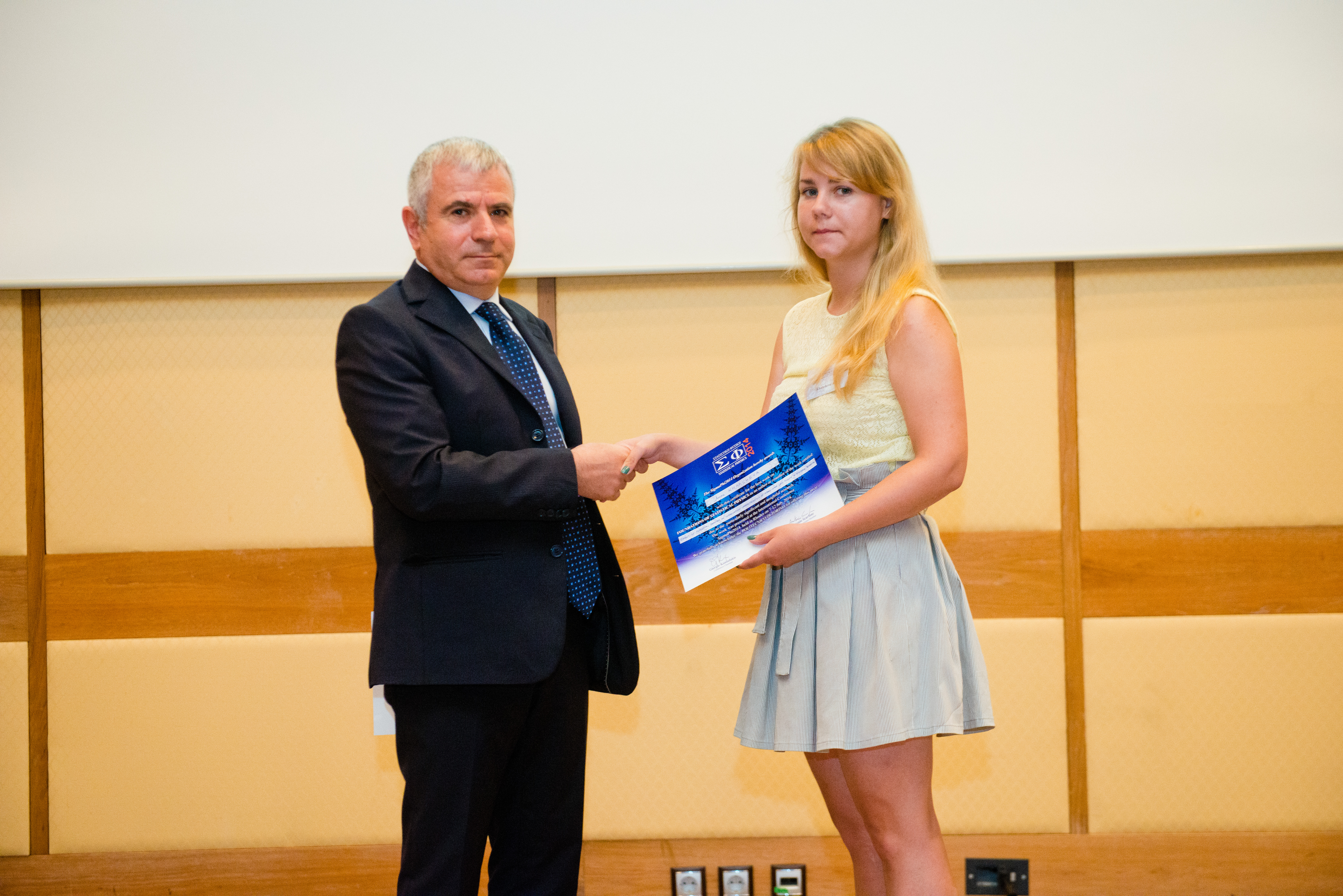
Kharcheva Anna (Lobachevsky State University, Nizhnii Novgorod, Russia)
Prize for the Best Work on Foundations of Statistical Physics
Title of the work: Effect of potential barrier on correlation characteristics of steady state Levy flights in bistable potential
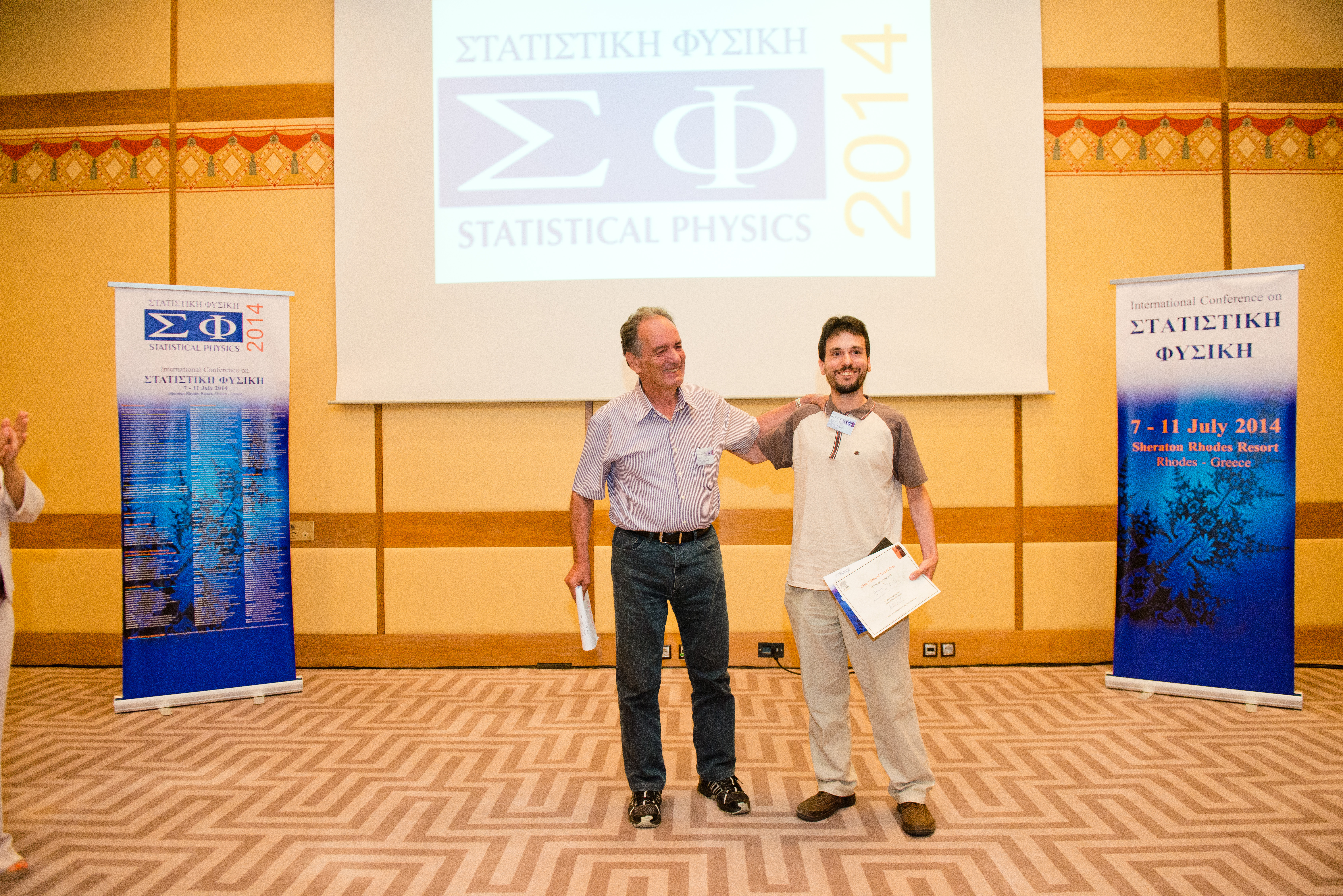
Tibely Gergely (Eotvos University, Budapest, Hungary)
Prize for the Best Work on Complexity
Title of the work: Hierarchies in tagged data
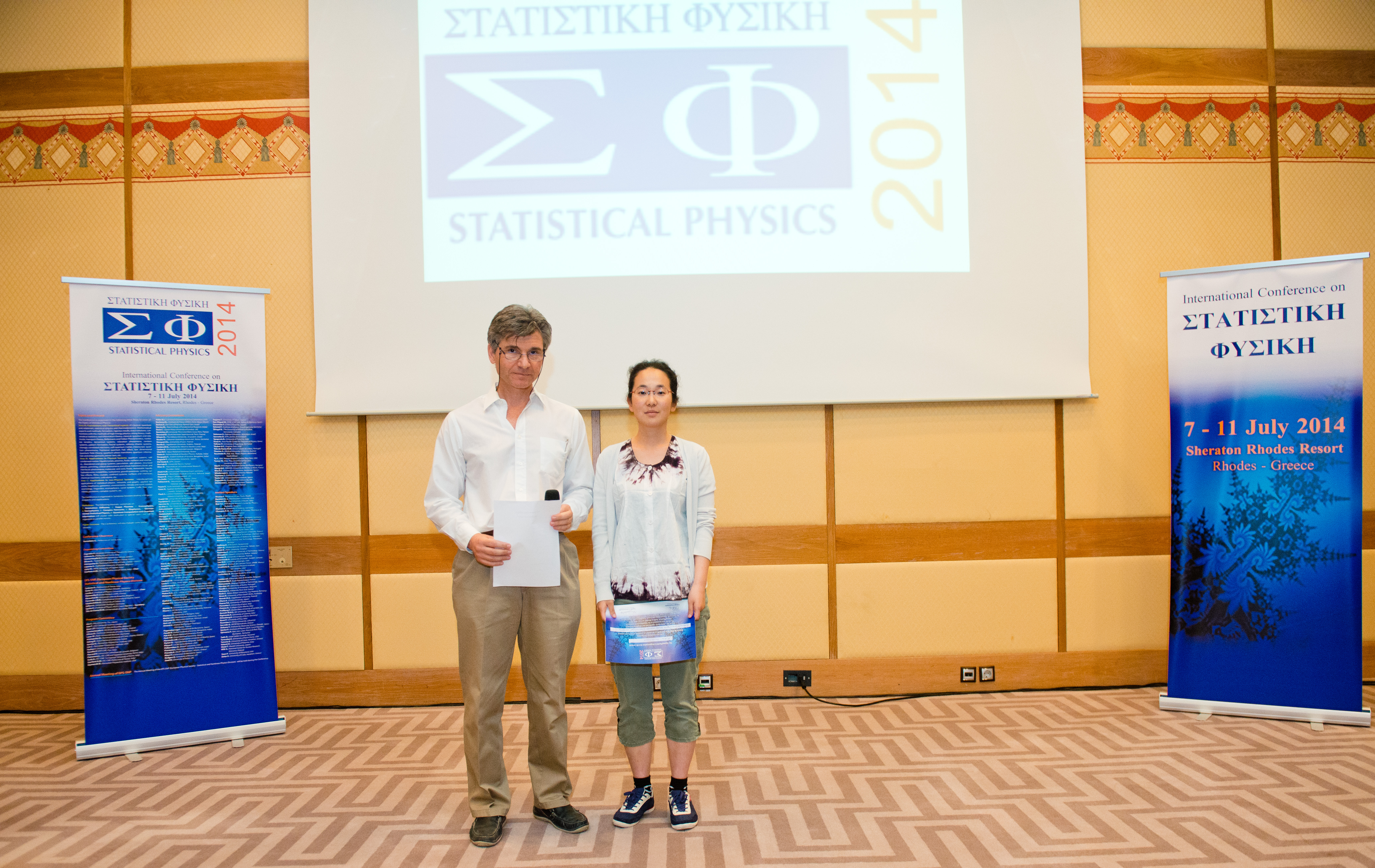
Shimokawa Michiko (Fukuoka Institute of Technology, Japan)
Prize for the Best Poster Presentation
Title of the work: Experimental study of fractal pattern observed in gravitational instability